TLDR
Rethinking Public Institutions — Devesh Kapur, Pratap Bhanu Mehta, Milan Vaishnav
Summary
The main goal is to examine the institutional foundations of the Indian state and the organizational and institutional context in which it operates. The central argument is that by not treating institutions as organizations, their inner workings are black-boxed and they are usually treated as a causal variable. The North framework treats institutions as a bundle of rules, but the book argues that institutions are “complex organizations with norms, culture, financial wherewithal, hiring and firing.” The contention is that improving the capacity of India’s public institutions is the “single biggest challenge that India faces in this century.”
Notes & commentary
Treating institutions as (causal variale) x is tricky — they normally do not really vary “exogenously.”
Pet peeve: why do org behavior departments not hire political scientists?
About a million people enter the working-age population every month. India added 364 million people to its population since 1991 — more than the stock during independence.
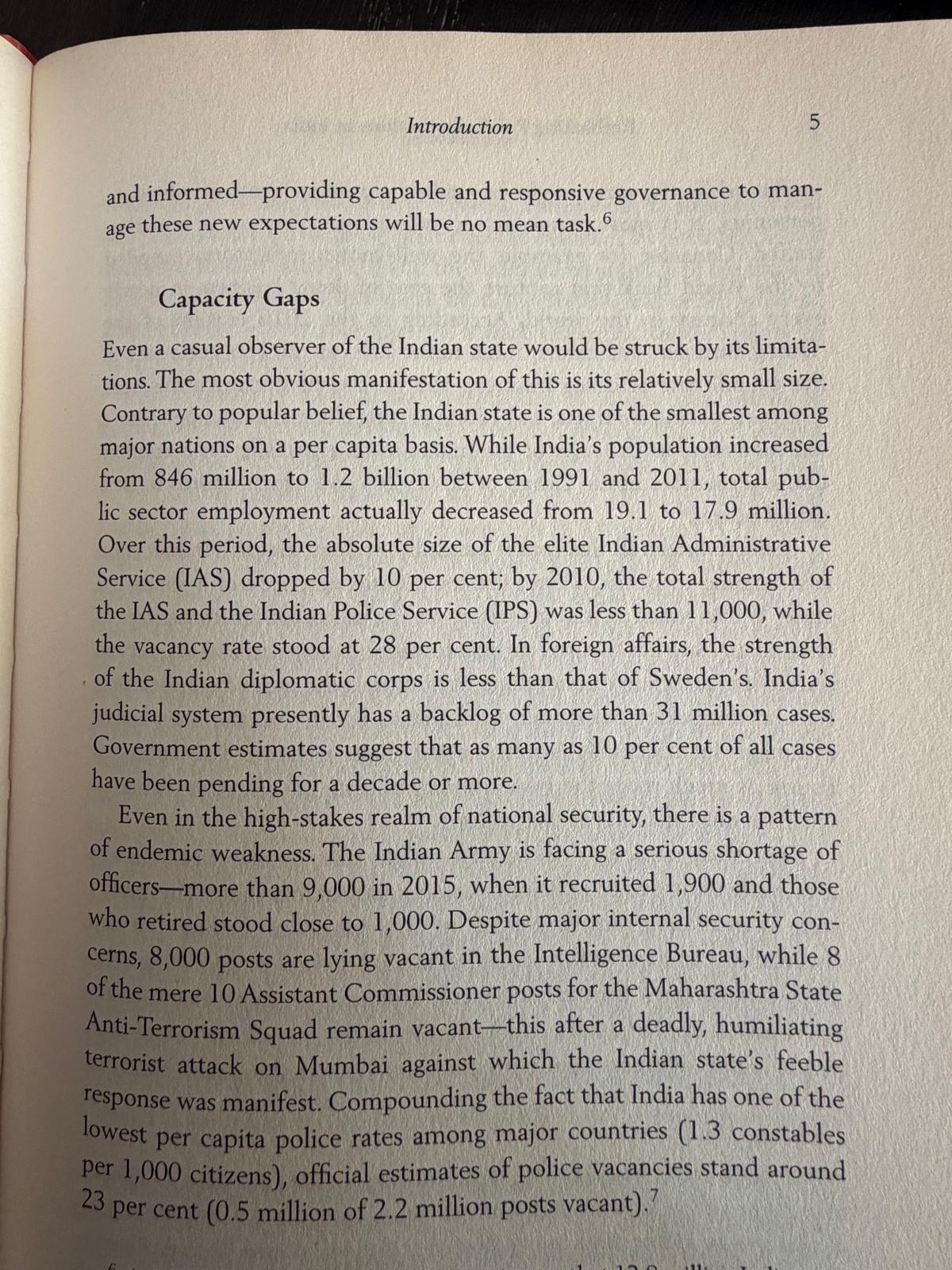
Empirical claim: The Indian state is one of the smallest among major nations on a per capita basis.
State capacity = ability of the state to effectively design and implement public policies.
Key themes:
-
Personnel failures — Staff shortfall. This is puzzling to me. Economy growing fast by all government statements, we have a lot of people. We are reducing the size of the state? Shortfall not just in aggregate, but even spatially. Leaving competence aside, the fact that we aren’t hiring suggests one of two things: 1) we want to keep the state small; 2) we are unable to find talent. Only 1 seems correct?
-
Legal ambiguity — Local governments are given mandate without commensurate resources (maybe this is what explains why quotas were extended to this?). CAG vs. ECI: they say that ECI has sweeping powers thanks to Art. 324. For CAG, however, Art. 149 states that CAG’s actions will be prescribed by an act of Parliament, meaning parliament will give it a mandate on when it chooses to act. CBI is “handmaiden” of the executive/government. Screaming “political vendetta” undermines any case in the public eye (even bona fide ones). It is interestig to see How things have changed with respect to the perceptions (of both incumbent and opposition parties) of ECI!
-
Coordination dilemmas — Horizontal, between government agencies: separate ministries for coal, environment, forestry, climate change, mines, renewable energy, oil and gas, and power — all related to energy! Minister is too powerful, or power is centralized within ministries. Vertical coordination between tiers of governance.
-
External accountability — To the public; book says this has improved, cites RTI, MGNREGA audits, etc.
-
Internal accountability — Not so positive: ministries are centralized, no outcome-based budgeting or performance evaluations.
-
Political interference — IAS, RBI, CEC, CBI.
The book describes the micro-dynamics of the following institutions. It is optimal strategy to read these individual chapters on a need basis, rather than doing a cover-to-cover read. Chapters listed here for reference:
- Presidency — James Manor
- Parliament — MR Madhavan
- The Supreme Court — Madhav Khosla and Ananth Padmanabhan
- RBI — Errol D’Souza
- Reforming India’s Institutions of Public Expenditure — Nirvikar Singh
- New Regulatory Institutions in Infrastructure: From De-politicization to Creative Politics — Navroz Dubash
- Institutions of Internal Accountability — R. Sridharan
- Foregrounding Financial Accountability in Governance — Amitabh Mukhopadhyay
- The Civil Service — KP Krishnan and TV Somanathan
- ECI — E. Sridharan and Milan Vaishnav
- Re-energizing Democratic Decentralization in India — RT Raghunathan
Further Reading
- In Spite of the Gods: The Strange Rise of Modern India — Edward Luce
- The Cost of Rights: Why Liberty Depends on Taxes - Stephen Holmes and Cass R Sunstein
- Institutions and Norms in Economic Development - Edited by Mark Gradstein, Kai A. Konrad